Your SMP Google Business Profile isn’t a directory listing. It’s the most powerful local SEO asset for SMP studios you have. Most studios are leaving it half-finished, misconfigured, or completely ignored.
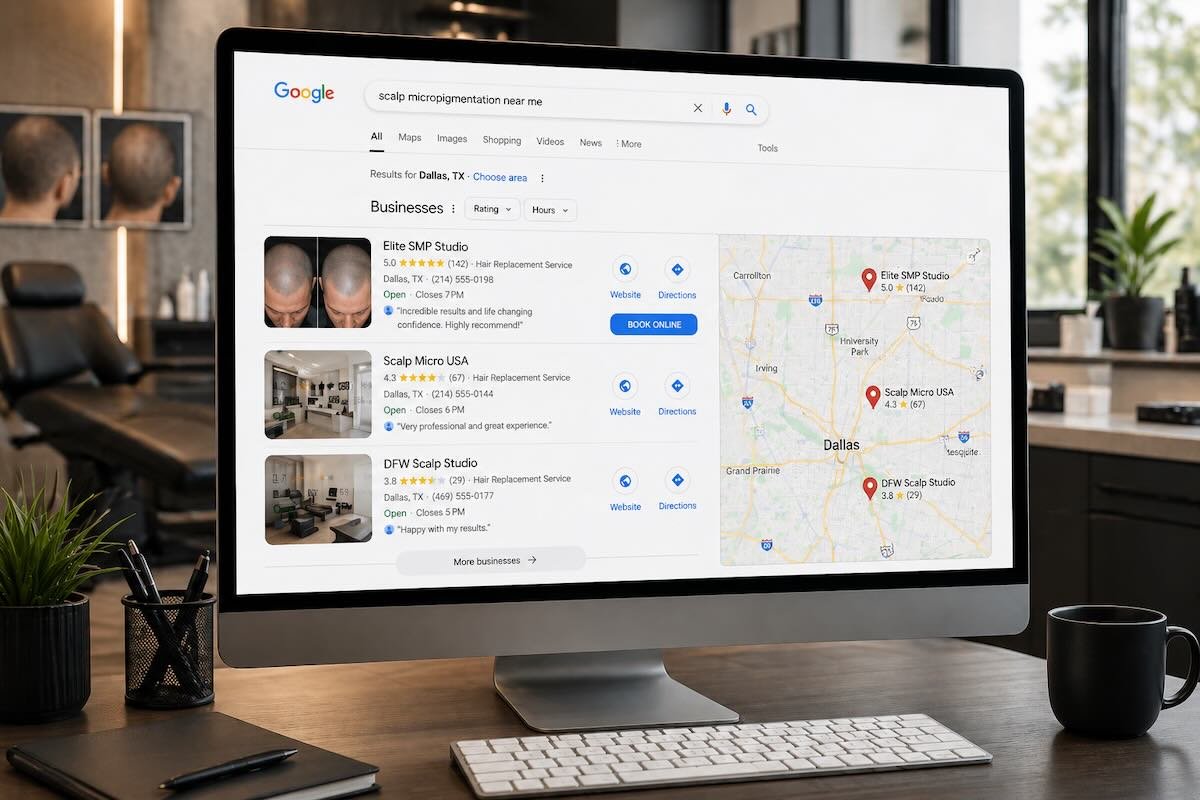
Here’s what that costs you: every time someone in your market searches “scalp micropigmentation near me” or “SMP studio [your city],” Google decides which 3 studios to show in the local pack. That decision is based largely on your Google Business Profile. If yours isn’t fully optimized, you’re handing clients to competitors who are.
This guide covers everything: from claiming and verifying your profile, to choosing the right categories, to generating reviews that actually rank. These are the same steps we use at Rogue Ink Marketing to optimize GBP profiles for SMP studios across North America.
If your profile isn’t working as hard as you are, this is where you start.
Key Takeaways
What category should SMP studios use on Google Business Profile?
“Hair Replacement Service” is the correct primary category. Most studios default to “Tattoo Shop” or “Beauty Salon.” Both misalign with how hair loss clients search. This single change is the highest-impact GBP optimization most studios haven’t made.
How do I get my SMP studio to show up in Google Maps?
A fully claimed, verified, and optimized Google Business Profile is the primary driver of local pack and Maps visibility. Category selection, photo volume, review consistency, and regular GBP posts all contribute to ranking.
How many photos does my SMP Google Business Profile need?
Start with a minimum of 25 before focusing on anything else. Competitive markets should target 75 or more. Add 4 to 6 new photos monthly. High-ranking profiles consistently have 50 to 100+ photos across exterior, interior, procedure, and healed result categories.
Do Google reviews affect my local search ranking for SMP?
Yes, directly. Review volume, recency, and keyword content all influence local rankings. Reviews that mention “scalp micropigmentation” or “SMP” carry more relevance weight than generic reviews. Responding to every review is also a confirmed Google ranking signal.
How often should I post on Google Business Profile?
At least once per week. Standard GBP posts expire after 7 days. A weekly cadence signals to Google that your business is active and engaged. Include a booking CTA in every post.
Can I have a GBP if I work from a private or home studio?
Yes. Set up your profile as a “service area business.” You define the geographic area you serve without displaying a home address. Google explicitly supports this setup for service-based businesses.
Other Notable Takeaways
- Your GBP profile controls your visibility in both Google Search and Google Maps. Neglecting it means losing ground in both places simultaneously.
- Most of your competitors haven’t fully optimized their GBP profiles. This is one of the fastest competitive wins available in SMP local SEO.
- The “From the business” description is 750 characters of indexable, keyword-relevant text. Most studios waste it on generic filler copy.
- GBP posts expire after 7 days. Studios that post once and forget it look abandoned to both Google and potential clients scrolling the profile.
- Review language matters. Coaching clients to mention “scalp micropigmentation” or “SMP” in their review text increases keyword relevance in local search.
- The GBP services section is free, indexed, and visible in search results. Listing specific services like “SMP for Alopecia” and “SMP for Women” generates relevance signals for high-intent queries most studios miss.
- Enabling the GBP messaging button and integrating a booking link removes friction at the highest-intent moment in the client journey. Most studios never activate either.
Table of Contents
Why Your Google Business Profile is Your #1 Local SEO Asset
When someone searches “scalp micropigmentation near me,” Google doesn’t automatically show the best artist. It shows the 3 businesses with the strongest local signals. Your Google Business Profile is the single biggest factor in that decision.
According to Google’s guide to improving your local ranking, GBP prominence, relevance, and distance are the 3 core factors that determine local pack placement.
The local pack (the 3 results with the map at the top of search) captures the majority of clicks for local service queries. If your studio isn’t in it, most potential clients will never find you. It doesn’t matter how good your website is or how many Instagram followers you have.
For SMP studios specifically, this matters more than almost any other service category. SMP clients are actively searching for solutions. They’re not passively scrolling. Someone typing “scalp micropigmentation [your city]” is already past the awareness stage. They know what they want and they’re looking for who to trust. A fully optimized GBP profile puts your studio directly in front of that client at exactly the right moment.
At Rogue Ink, we work exclusively with SMP studios and artists. One of the most consistent findings across every market: the studios dominating local search for scalp micropigmentation aren’t necessarily the most experienced. They’re the ones with the most optimized GBP profiles. Most of your competitors haven’t done this work. That’s your opportunity.
STEP 1: Claim and Verify Your Profile the Right Way
Before you can optimize anything, you need to own your profile. Go to business.google.com and search for your studio name before creating anything new. Google often auto-generates listings from third-party data sources. If yours already exists, claim it. Don’t create a duplicate.
Duplicate profiles split your review equity, confuse Google about your business entity, and suppress your ranking. If you find a duplicate, flag it for removal through Google’s support process.
Once you’ve confirmed there’s no existing listing, create your profile and go through verification. The Google Business Profile Help Center walks through all current options. Google currently uses 3 main verification methods:
- Postcard: A physical code mailed to your business address (5 to 7 business days)
- Phone or email: Available for some accounts, faster but not always offered
- Video verification: Increasingly common. Google asks you to record a short video showing your business location, storefront, and equipment
Unverified profiles don’t rank in the local pack. This is non-negotiable. Complete verification before spending time on any other optimization.
What If Your Studio Is Already Listed?
If someone already created a listing for your studio, or if Google generated one automatically, you’ll need to request ownership. Go to the listing, click “Claim this business,” and follow the verification steps.
If the listing has wrong information (old address, wrong phone number, incorrect hours), you can edit it once you’ve claimed and verified ownership. Don’t ignore these errors. Inconsistent business information is a local ranking penalty.
Mobile SMP Artists: How to Set Up a Service Area Business
Work from a private studio, a home setup, or travel to clients? You can still have a fully functional GBP profile. Just set it up as a “service area business.”
Instead of displaying a physical address, you define the geographic area you serve: specific cities, a radius, or a region. Google will still rank your profile for local searches within that area.
One important rule: don’t publish your home address publicly if you work from home. Set the location as your service area only. Google’s guidelines allow this, and it protects your privacy while keeping you visible in local search.
STEP 2: Choose the Right Business Category (Most Studios Get This Wrong)
The correct primary Google Business Profile category for SMP studios is “Hair Replacement Service.” Most studios default to “Tattoo Shop” or “Beauty Salon.” Both misalign with the actual client intent. “Hair Replacement Service” tells Google exactly what you offer and matches how hair loss sufferers search for solutions. This one change can meaningfully improve local pack placement.
That’s the short answer. Here’s the full picture.
Google uses your primary category to determine which searches your profile is eligible to appear for. If you’re listed as a “Tattoo Shop,” you’re competing against tattoo artists, not hair loss clinics. Your ideal clients are searching for hair restoration solutions, not tattoos. The category mismatch costs you visibility with exactly the people who want what you offer. Review Google’s guidelines for representing your business to understand how categories affect eligibility.
Primary vs. Secondary Categories
GBP allows up to 10 categories total: 1 primary and up to 9 secondary. Your primary category carries the most weight. Choose it carefully and don’t change it frequently. Category changes can trigger a re-verification process and temporarily affect rankings.
Recommended secondary categories for SMP studios:
- Permanent Make-Up Clinic
- Tattoo Shop (if SMP is offered alongside traditional tattoo services)
- Hair Loss Treatment Clinic
- Medical Spa (if operating in a clinical setting)
Keep secondaries tightly aligned to actual services. Adding unrelated categories to cast a wider net backfires. It dilutes relevance and can trigger a guideline violation review.
STEP 3: Write a Business Description That Works for SMP Clients
The “From the business” description field gives you 750 characters. That’s 750 characters of indexable, searchable text sitting directly on your Google Business Profile. Most SMP studios fill it with something like “Professional SMP studio serving [city]. Book your consultation today.”
That’s not a description. That’s a missed opportunity.
Your GBP description isn’t just for humans reading your profile. Google indexes it as part of your local search relevance signals. Write it the same way you’d approach any piece of SEO copy: keyword-intentional, benefit-forward, and locally anchored.
Here’s a framework that works:
- Name the service specifically. Use “scalp micropigmentation,” not “hair tattoo” or “hair pigmentation.” Google and your clients both need the precise term.
- Reference the client problem. Mention hair loss, thinning, receding hairlines, or alopecia. These are the words your ideal clients are typing into search.
- Include a local signal. Name your city or service region. This reinforces your geographic relevance.
- Add a trust element. Certified artists, years of experience, number of procedures completed. Something concrete.
- Close with a soft CTA. “Free consultations available” or “Book online.” Keep it natural, not pushy.
| EXAMPLE DESCRIPTION “[Studio Name] specializes in scalp micropigmentation for men and women experiencing hair loss, thinning, or alopecia. Our certified SMP artists have completed [#] procedures across [City/Region], delivering natural-looking hairlines and density using industry-leading techniques. Free consultations available. Book online or call us directly.” |
750 characters is enough to cover all 5 elements without padding. Use every one.
STEP 4: Build Out Your Services Section
Most SMP studios skip the GBP services section entirely. That’s a mistake. It’s free, indexed, and visible directly in local search results.
The services section lets you list individual offerings with a name, description (up to 300 characters), and optional price. Google surfaces these in the profile and uses them as relevance signals for specific search queries.
Services to add to every SMP profile:
- Scalp Micropigmentation: your primary service, always first
- SMP for Hair Loss: targets the core search intent
- SMP for Alopecia: covers a specific, high-intent client segment
- SMP for Receding Hairlines: another high-intent variation
- SMP for Women: often overlooked; women represent a significant segment of SMP clients
- SMP Touch-Up Session: relevant for past clients searching for maintenance
- SMP Consultation: adding the consultation as a service drives direct booking intent
Write each service description like a micro-ad. 100 to 150 characters, keyword-present, benefit-stated. “Natural-looking density and hairline restoration using advanced scalp micropigmentation techniques” does more work than “Scalp micropigmentation service.”
STEP 5: Upload Photos That Actually Convert
Photos are the most underinvested element of the average SMP Google Business Profile, and one of the highest-impact ranking and conversion signals available.
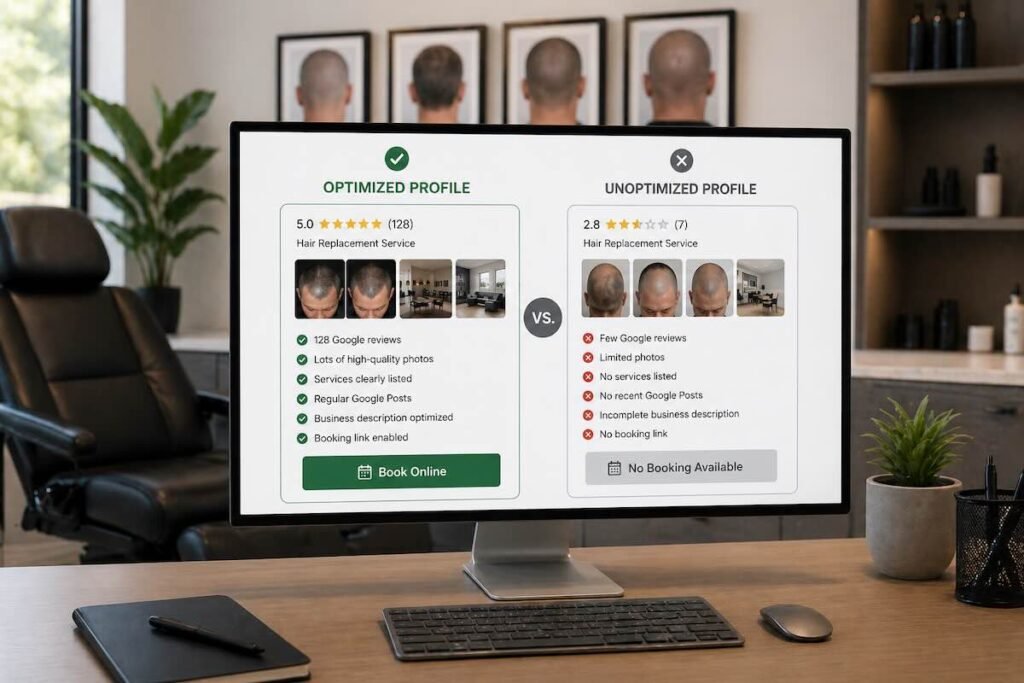
Here’s the gap: most SMP studios have 5 to 10 photos on their GBP. Studios that consistently hold top positions in the local pack have 50 to 100 or more. Google treats photo volume and engagement (views, clicks, saves) as behavioral signals. A profile with an active, growing photo library signals an active, engaged business.
There are 4 categories every SMP profile needs:
1. Exterior photos
Help clients find your studio and confirm the business is real. Include the building facade, parking, and signage. This is basic trust infrastructure.
2. Interior photos
The studio environment is a major trust signal for SMP clients. They’re about to sit in your chair and let someone work on their scalp. Show a clean, professional space. Include the consultation area, treatment room, and any equipment that signals professionalism.
3. Procedure photos
Showing the artist at work, with client consent, builds comfort with the process. Many clients are nervous about needles and the procedure setting. Normalizing the experience through photos reduces friction at the consultation stage.
4. Healed results
Before/after photos showing fully healed, natural-looking SMP results are your highest-conversion photo type. These are the photos that turn profile viewers into consultation bookings. The more diverse the client demographics, hair loss patterns, and skin tones represented, the better.
Google also allows video uploads. A 30 to 60 second studio walkthrough or a healed-result showcase video drives significantly higher engagement than still photos alone.
How Many Photos Does Your Profile Need?
| Minimum | 25 photos before investing time in any other optimization activity. |
| Competitive | Target 75 or more in competitive markets. |
| Cadence | Add 4 to 6 new photos per month. Consistent additions outperform a single large batch upload every time. |
STEP 6: Generate Reviews That Rank and Convert
Reviews are the most powerful ongoing ranking and conversion signal your GBP profile has. According to BrightLocal’s annual Local Consumer Review Survey, the vast majority of consumers read reviews before visiting or contacting a local business. For SMP clients making a high-stakes, emotionally loaded decision about their appearance, reviews aren’t just helpful. They’re decisive.
The problem most studios have isn’t getting good reviews. It’s generating them consistently and strategically.
There are 3 components to a review strategy that actually works for SMP:
1. Timing and generation
The best time to request a review is 3 to 4 weeks post-procedure, when healing is complete and the client is experiencing full results. Not the day of the procedure. Not 3 months later.
Automated follow-up via text or email outperforms manual requests every time. Set up a short sequence: a care check-in at 2 weeks, a review request at 3 to 4 weeks, and a single reminder 7 days later if they haven’t responded.
2. Language coaching
This is the piece most GBP guides completely miss.
Reviews that mention “scalp micropigmentation,” “SMP,” “hairline,” “hair loss,” or “alopecia” carry more keyword relevance than generic “great experience, 5 stars” reviews. Google’s algorithm reads review text as part of your local relevance signal. The words your clients use in reviews influence which searches your profile appears for.
Coach clients with a simple prompt: “If you’re comfortable leaving a Google review, it would mean a lot. If you mention that you came in for scalp micropigmentation and what your experience was like, that helps other people in the same situation find us.” Natural, not scripted.
3. Response strategy
Google has confirmed that responding to reviews is a local ranking signal. Respond to every review, positive and negative, within 24 to 48 hours.
For positive reviews: thank the client by name, reference the service, and include a keyword naturally. “Thank you, [Name]. We’re so glad your scalp micropigmentation results have held up well.”For negative reviews: acknowledge, don’t argue, and take it offline. One professional response to criticism demonstrates more credibility than ten perfect reviews. SMP clients researching your studio will read how you handle complaints. Make it count.
For more on converting leads once you have them, see our guide on how to get SMP clients. just asking for favors.
STEP 7: Use GBP Posts to Stay Active and Visible
GBP posts are the most overlooked active ranking signal available to SMP studios. Most profiles have zero posts, or posts from over a year ago. That signals to Google that the business may be inactive or disengaged.
Standard GBP posts expire after 7 days. If you’re not posting regularly, your profile looks stale. That matters for both Google’s ranking algorithm and for potential clients who scroll your profile and see outdated activity.
Treat GBP posts like profile maintenance, not social media. The goal isn’t viral engagement. It’s consistent activity signals and direct client touchpoints at peak search intent.
A simple posting framework for SMP studios:
- Weekly: A healed result or before/after photo with 100 to 150 words of context. Keep it focused on the transformation and the client experience, not technical jargon.
- Every 2 weeks: A service spotlight post covering one specific SMP service with a booking CTA. Rotate through your service menu: SMP for alopecia, SMP touch-up sessions, SMP for women.
- Monthly: An FAQ or educational post answering one common SMP question. “How long does SMP last?” “Does SMP work for all skin tones?” “What’s the difference between SMP and a hair tattoo?” These build trust and generate engagement from clients still in the research phase.
Every post should include a CTA button. “Book” drives the highest conversion rate for SMP profiles. Include a link back to your website’s consultation or booking page. GBP posts drive referral traffic directly to service pages when the link is set up correctly.
STEP 8: Set Up Messaging and Booking Links
Your GBP profile has 2 direct conversion tools built in. Most SMP studios never activate them.
Messaging
Enabling the message button lets potential clients contact your studio directly from the Google search results, before they ever visit your website. For a client in active research mode, this is a zero-friction first contact.
The catch: Google monitors your response time. Profiles that respond to messages within an hour get the messaging button displayed prominently. Slow response times, or no responses, suppress the feature. If you enable messaging, commit to monitoring it daily.
Booking links
If your studio uses an online booking platform (Vagaro, Mindbody, Calendly, Jane App, or similar), you can integrate the booking link directly into your GBP profile. A “Book” button appears in search results. One tap takes a high-intent searcher directly to your booking page.
That’s the shortest possible path from finding your studio in Google to having a consultation booked. Every additional step a client has to take is a step where you can lose them. Eliminate as many as possible at this stage.
If you’re also running Google Ads for your SMP studio, pairing paid search with a fully optimized GBP profile creates maximum visibility at both the top and map sections of search results.
Common GBP Mistakes SMP Studios Make
Even studios that go through the setup process leave gaps. These are the errors we see most consistently when auditing SMP Google Business Profiles. Every one of them is fixable today.
Wrong business category
Listing as “Tattoo Shop” or “Beauty Salon” instead of “Hair Replacement Service” is the most common and most damaging mistake. It misaligns your profile with the searches that matter most.
Neglecting photos
5 to 10 photos won’t compete against profiles with 50 to 100. Volume, variety, and recency all signal profile quality to Google.
Treating setup as a one-time task
GBP is a system, not a form. Posts expire. Reviews need responses. New photos need to be added. Studios that set it and forget it fall behind studios that actively maintain their profiles.
Not responding to reviews
Every unanswered review, positive or negative, is a missed signal. Review responses are a ranking factor and a trust signal. Both matter.
Missing the booking link
If clients have to navigate from Google to your website to your booking page to a booking form, you’re adding friction at the highest-intent moment in the client journey. Integrate your booking link directly into the profile.
How to Track Your GBP Performance
Optimization without measurement is guesswork. GBP’s built-in Insights dashboard gives you the metrics that tell you whether your profile is working.
The numbers to track:
- Search queries: What keywords are triggering your profile in search? This is your real-world keyword data. Use it to refine your description and posts.
- Profile views: How many people are seeing your listing in search and on Maps?
- Direction requests: People navigating to your studio. A strong intent signal.
- Website clicks: Traffic your GBP profile is directly driving to your website.
- Phone calls and messages: Direct contact actions taken from the profile.
Check Insights monthly. Look at 90-day trends rather than week-to-week fluctuations. Short-term variance is normal; trend direction is what matters.
If you’re using Google Search Console, correlate your GBP data with organic search performance to understand the full picture. For studios running a full SMP search marketing strategy, combining GBP Insights with Search Console data shows exactly where clients are finding you and where gaps remain.
One warning sign: a sudden drop in profile views often indicates a category, content, or guideline issue. If views fall sharply without an obvious reason, do a full profile audit before assuming it’s a seasonal fluctuation.
Ready to Own Your Local Market?
Your Google Business Profile is the fastest competitive win in SMP local SEO. Most of your competitors haven’t done this work. The gap is real, and it’s closeable right now.
This isn’t a one-and-done checklist. Consistent posts, new photos, ongoing review generation, and active profile maintenance are what separate studios that hold local pack rankings from ones that appear for 3 weeks and fade. Treat your GBP like a system, not a form.
If you want your SMP studio to own its local market, not just show up in it, this is the foundation. Build it right, then build on it.
Ready to go further? Our SMP Local SEO service covers everything from GBP to full local search domination. We work exclusively with SMP studios, so you’re not getting generic advice adapted from a dental office playbook.
Apply now to Get Started with Rogue Ink and let’s see if your studio is a fit.
Final Thoughts
Your Google Business Profile isn’t set-it-and-forget-it. It’s a living asset that rewards consistency. Studios that show up in the local pack month after month aren’t getting lucky; they’re posting regularly, adding photos, responding to reviews, and treating GBP maintenance as part of running the business.
The good news: most of your competitors aren’t doing this. The gap is wide open, and the steps to close it are right here.
Start with verification and category selection. Build your photo library. Get your review system running. Then stay active.
Done right, your GBP becomes a client acquisition engine that works around the clock. No ad spend required.