
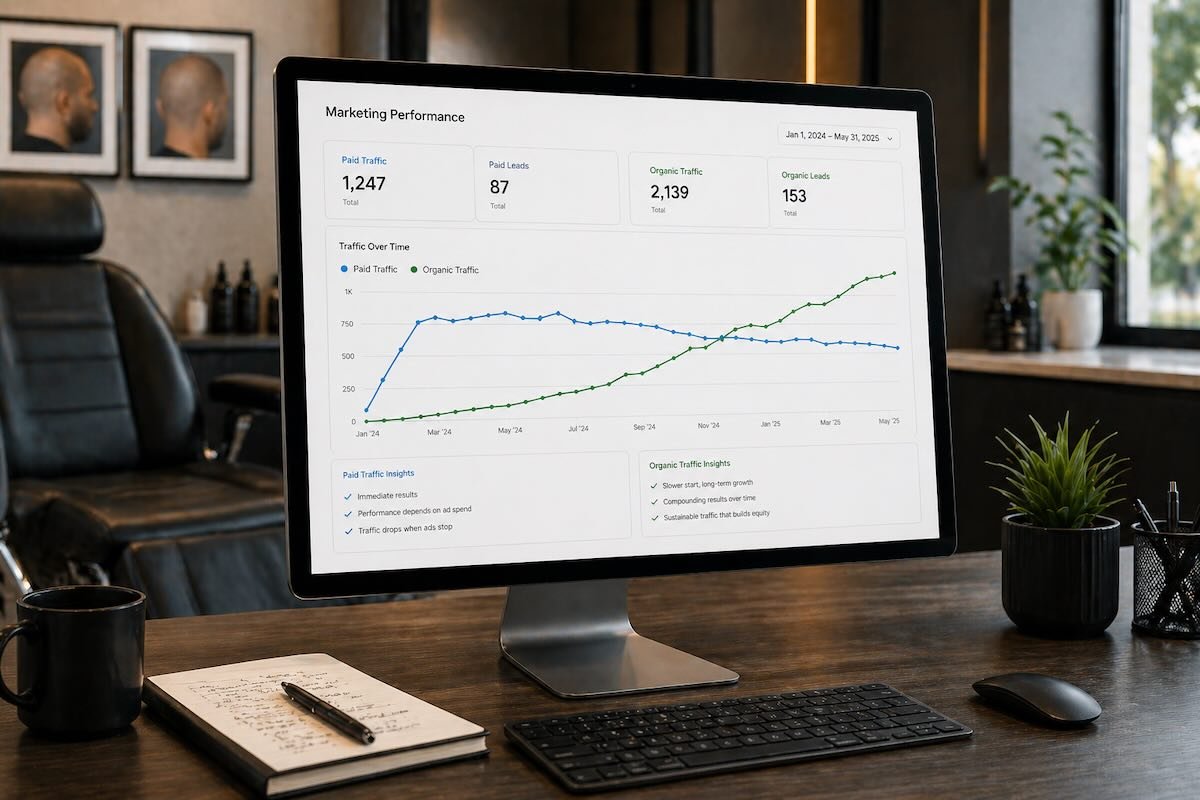
Most articles about SEO vs PPC were written for generic small businesses. Dentists. Contractors. Plumbers. The advice is fine, but it doesn’t account for the specific reality of running a scalp micropigmentation studio.
SMP clients don’t book on impulse. They research for weeks, sometimes months, before reaching out for a consultation. That behavioral pattern changes how you should think about marketing channels. It changes how you evaluate speed, cost, and conversion. It changes which channel you prioritize first.
This guide doesn’t treat you like a generic small business. It breaks down SEO vs PPC specifically for SMP studios, with the actual numbers and decision criteria you need to make the right call.
We’re a scalp micropigmentation marketing agency that works exclusively in this niche, and if you want to see how combining SEO and paid search into one system works in practice, that’s covered on our Blended Search Marketing page.
Key Takeaways
What’s the main difference between SEO and PPC for SMP studios?
SEO earns you free, compounding visibility in Google search and Maps over time. PPC (Google Ads) buys you immediate placement at the top of search results, but stops the moment you stop paying. Both target the same high-intent local searches. The difference is how fast they deliver leads and what happens to those leads if you stop investing.
How long does SEO take to deliver leads for an SMP studio?
Most scalp micropigmentation studios see early movement in Google Maps and Google Business Profile rankings within 30–60 days of proper optimization. Consistent inbound leads from organic website rankings typically arrive by month 4–6. The timeline depends on your market’s competition level and whether your website and GBP are properly optimized when you start.
How much should an SMP studio budget for Google Ads?
A working Google Ads campaign for most local SMP studios requires a minimum of $500–$750 per month in ad spend. Below that threshold, campaigns don’t get enough data to optimize properly. Budget matters less than campaign structure. The studios that waste money on PPC almost always have the wrong landing page, not the wrong budget.
Can you run SEO and PPC at the same time for an SMP studio?
Yes, and running both simultaneously is the most effective approach. PPC delivers leads while your SEO rankings build. SEO reduces your dependence on paid traffic over time. Studios that run both from the start avoid the dead zone: the 3–6 month window where SEO-only studios have zero search-driven leads.
Which channel gives better ROI for SMP studios?
Long-term, SEO delivers better ROI. Once you’re ranking, leads come in without ongoing ad spend. Short-term, PPC delivers it faster. The honest answer is that the channel with better ROI is the one you’re using correctly. A poorly structured PPC campaign loses money. An abandoned SEO strategy returns nothing. Execution matters more than channel choice.
When should an SMP studio move from one channel to both?
If you started with PPC, begin building SEO as soon as you have a consistent lead flow. Don’t wait until you need it. If you started with SEO, add PPC the moment you have budget and a proper landing page in place. Most studios are ready to run both by month 2–3 of working with a dedicated SMP marketing partner.
Other Notable Takeaways
- SMP search keywords are still low-competition compared to most service verticals. First-mover SEO advantage is real and available now.
- Sending Google Ads traffic to your homepage instead of a dedicated SMP landing page is the single biggest PPC mistake studios make.
- Google Business Profile (Maps) rankings move faster than organic website rankings. It’s the highest-priority local SEO asset for SMP studios.
- Running PPC and SEO together eliminates the dead zone: the 3–6 month period where SEO-only studios have no search-driven leads.
- Both channels target the same high-intent prospect: someone already searching “scalp micropigmentation near me” and ready to book a consultation.
Table of Contents
Why This Question Matters for SMP Studios
Most articles about SEO vs PPC were written for any business, and that’s the problem. The SEO vs PPC debate looks different for a scalp micropigmentation studio than it does for a plumber or a dentist.
SMP clients research for weeks before they reach out. They compare studios. They look at healed results. They read reviews.
That long consideration cycle means marketing channels that build authority and visibility over time match SMP buyer psychology better than most industries. It also means fast-moving paid campaigns need to be structured specifically for how SMP clients actually evaluate and book.
Get this decision right and your calendar fills. Get it wrong and you either wait months with empty chairs or burn through ad budget with no bookings to show for it.
Here’s how to get it right.
What’s the Difference Between SEO and PPC for SMP Studios?
SEO (search engine optimization) is the process of earning organic visibility in Google’s search results and Maps without paying per click. It’s a long-term asset you build, and it compounds over time. PPC (pay-per-click, typically Google Ads) means paying to appear at the top of search results the moment someone types an SMP-related query.
Here’s the core difference: SEO builds something you own. PPC rents visibility that disappears when you stop paying. Both channels target the same high-intent prospects, people already searching “scalp micropigmentation near me” and ready to book a consultation. They just deliver access to those prospects on very different timelines.
| SEO | PPC (Google Ads) | |
|---|---|---|
| Time to first leads | 1–6 months | Days to weeks |
| Cost model | Time + effort upfront, then compounding | Ongoing ad spend per click |
| If you stop investing | Rankings hold temporarily, then fade | Visibility stops immediately |
| Local strength | Very high. Maps and GBP are powerful for SMP. | Very high. Appears above organic results. |
| Best for | Long-term pipeline building | Immediate lead generation |
What SEO Does for a Scalp Micropigmentation Studio
Local SEO for SMP studios works on two tracks, and the faster one surprises most studio owners.
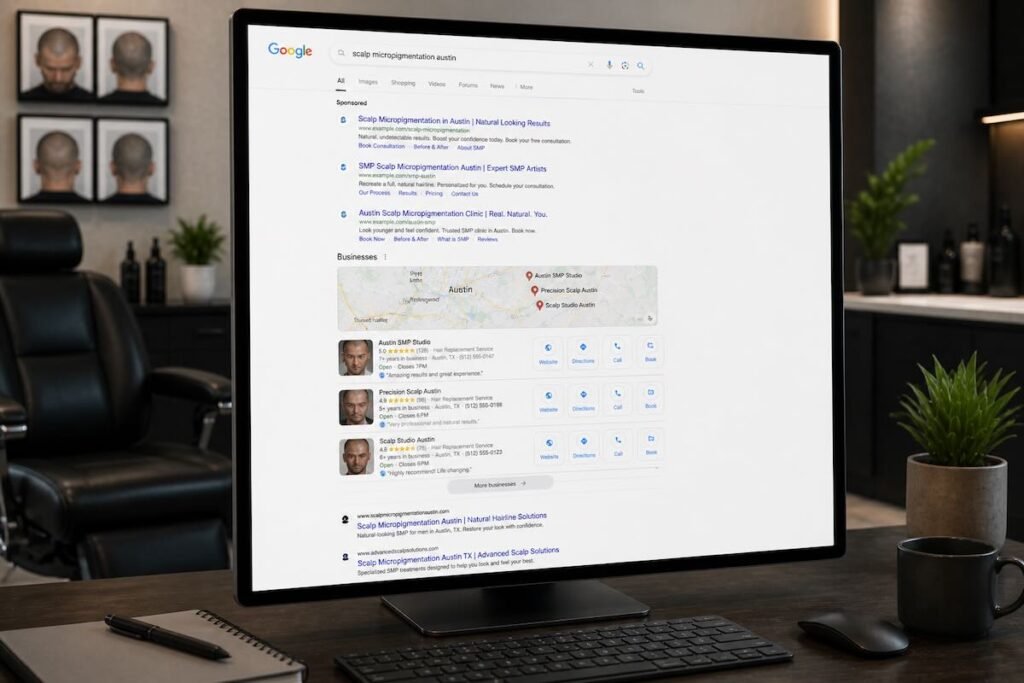
Track 1: Google Business Profile and Maps rankings. When someone searches “scalp micropigmentation near me” or “SMP studio [city],” Google typically shows a Maps pack: 3 local studios with ratings, hours, and a direct booking link. Ranking in that pack is often more valuable than ranking #1 in the blue-link results. It drives direct calls and consultation requests. A properly set up and optimized Google Business Profile with the right category, 75+ photos, consistent review flow, and regular posts can show meaningful ranking improvement in 30–60 days.
Track 2: Organic website rankings. This is the slower track. Consistent inbound leads from organic search typically arrive around month 4–6. But once your studio’s website ranks for “scalp micropigmentation [city]” and related queries, those rankings send free, qualified leads month after month without additional ad spend.
The advantage most SMP studios miss: keyword competition in scalp micropigmentation is still low compared to industries like dentistry or cosmetic surgery. Agencies have been hammering those niches for 15 years. SMP is still early. Studios ranking their SMP practice in local search now have genuine first-mover advantage before the market gets crowded.
If you want the complete system for bringing new scalp micropigmentation clients through your door, that guide covers every channel from the ground up.
What Google Ads Does for a Scalp Micropigmentation Studio
The reason Google Ads works for SMP is simple: intent is already high.
Someone typing “scalp micropigmentation [city]” or “SMP studio near me” isn’t browsing. They’ve researched the procedure. They’ve looked at before and afters. They’re ready to evaluate studios. A Google Ad puts your studio at the top of that page, in front of that prospect, before they ever scroll to the organic results.
PPC delivers speed. You can have a campaign running and generating consultation requests within days of launch. For studios that need leads now, whether you’re new to a market, have open chair time, or came off a slow month, that immediacy is the whole argument for starting with ads.
But here’s what the generic articles won’t tell you: most SMP studios that “tried Google Ads and it didn’t work” made the same two mistakes.
Mistake 1: Sending ad traffic to the homepage. Your homepage is built for people who already know you. Your ads reach people who’ve never heard of your studio. They need a dedicated SMP landing page, focused entirely on the consultation booking, with your work, your process, your testimonials, and a single call to action.
Mistake 2: Running too broad a geographic radius. SMP clients will travel for a great artist, but most won’t drive 90 minutes for a first consultation. Tight geographic targeting keeps cost-per-click down and lead quality up.
Running Google Ads built specifically for SMP studios requires a minimum of $500–$750/month in ad spend to work properly. Below that threshold, campaigns don’t accumulate enough data to optimize. The good news: SMP keywords are cheaper per click than most cosmetic procedures.
The Honest Tradeoffs: SEO vs PPC Side by Side
No channel is perfect. Here’s what you’re actually getting with each:
| SEO | PPC (Google Ads) | |
|---|---|---|
| Speed to leads | Slow. 1 to 6 months. | Fast. Days to weeks. |
| Monthly cost | Lower long-term | Ongoing. Never stops. |
| Lead consistency | Builds over time, then reliable | Consistent while budget is active |
| What happens if you stop | Rankings hold for a while, then fade | Leads stop immediately |
| Risk | Time investment before payoff | Budget waste without right structure |
| SMP buyer match | Strong. Matches long consideration cycle. | Strong. Captures high-intent moments. |
These channels aren’t competitors. They’re complements. SEO’s weakness (slow start) is PPC’s strength. PPC’s weakness (permanent ongoing cost) is SEO’s strength. Studios that treat this as a binary choice are leaving leads on the table.
So Which One Should Your SMP Studio Start With?
The answer depends on your studio’s current situation, not on which channel is objectively “better.”
Start with SEO if:
- You’re building for the long term and can handle a 3–6 month window with limited search-driven leads
- Your Google Business Profile isn’t fully optimized yet (fix this first, regardless of which channel you choose)
- You’re in a lower-competition local market where organic rankings are achievable faster
- You don’t have the budget to sustain $500+ per month in ongoing ad spend
- You want to build an asset you own, not rent visibility indefinitely
Start with PPC if:
- You need leads now. You have open chair time, you’re launching in a new market, or referrals have slowed.
- You have at least $500–$750/month in ad spend available
- You have (or can build) a dedicated SMP landing page, not your homepage
- You want to test which messages and offers convert before committing to long-form SEO content
- You’re in a competitive local market where organic rankings will take longer to build
If you can run both from the start? Do both. The studios that build the fastest stop treating SEO and PPC as an either/or decision.
The SMP Growth Sequence: Why the Best Answer Is Both
At Rogue Ink Marketing, we use a framework called the SMP Growth Sequence with every studio we work with. It’s not complicated, but it’s the reason pairing paid lead generation with organic search authority consistently outperforms single-channel approaches.
Phase 1: Build and activate simultaneously. From day one, we’re working the SEO foundation (GBP optimization, on-page content, local citations) while running PPC to generate leads in the near term. The ads fill your calendar while the organic infrastructure builds in the background.
Phase 2: SEO takes over. By month 4–6, organic rankings and Maps visibility are driving consistent inbound leads. At that point, your dependence on paid traffic drops, and your cost-per-lead drops with it. PPC budget can be reduced, optimized, or redirected toward geographic expansion.
The result: you never sit in the dead zone. SEO-only studios spend months with no search-driven pipeline. PPC-only studios pay forever and own nothing. The SMP Growth Sequence eliminates both failure modes by running the channels in parallel, with each doing the job it’s built for.
SEO vs. PPC for SMP Studios FAQs
How long does SEO take to deliver leads for an SMP studio?
Most scalp micropigmentation studios see early movement in Google Maps and Google Business Profile rankings within 30–60 days of proper optimization. Consistent inbound leads from organic website rankings typically begin around month 4–6. The timeline depends on your local market’s competition level, the current state of your website, and whether your GBP is fully optimized when you start.
How much should an SMP studio budget for Google Ads?
A minimum of $500–$750 per month in ad spend is needed for a Google Ads campaign to generate enough data to optimize properly. Campaigns below that threshold rarely perform. They don’t accumulate enough clicks and conversion data to improve. Keep in mind: budget matters less than structure. The most common reason SMP studios waste PPC money is sending traffic to the wrong page, not running with too small a budget.
Can you run SEO and PPC at the same time for an SMP studio?
Yes, and it’s the recommended approach. Running both simultaneously eliminates the dead zone: the 3–6 month window where SEO-only studios are building rankings but generating little search-driven pipeline. PPC fills that gap while SEO builds the long-term asset. As organic visibility grows, your dependence on paid traffic and your cost-per-lead both decrease.
Which channel delivers better ROI for SMP studios?
Long-term, SEO delivers better ROI. Once you’re ranking, leads arrive without ongoing ad spend. Short-term, PPC delivers it faster. The honest answer is that ROI depends almost entirely on execution, not channel. A poorly structured PPC campaign loses money. An abandoned SEO strategy returns nothing. The channel with better ROI is the one being managed correctly for your market.
What happens to my leads if I stop running Google Ads?
They stop immediately. The moment you pause a campaign, your ads disappear from search results and lead flow from that channel drops to zero. That’s why building SEO in parallel matters: if you ever need to pause or reduce ad spend, your organic and Maps rankings are already generating leads to bridge the gap.
I tried Google Ads before and got no leads. What went wrong?
The two most common culprits are the wrong landing page and the wrong geographic targeting. If your ads sent traffic to your homepage, conversion rates will be low. People who’ve never heard of your studio need a focused consultation page, not a general website. If your geographic radius was too broad, you paid for clicks from prospects too far away to book. SMP-specific campaign structure matters as much as budget.
Final Thoughts
SEO and PPC both work for scalp micropigmentation studios. The question was never which one is better. It’s which one fits where your studio is right now, and how quickly you can build toward running both.
If you want a clear picture of where your studio stands, what your local search visibility looks like, what a realistic PPC budget would deliver, and which channel to prioritize first, that’s exactly what a Discovery Session covers.
SMP is all we do. Every studio we work with goes through this exact analysis before a single dollar of ad spend or an hour of SEO work begins.